Most people don't think about what's under the asphalt on Glendale Avenue until a pothole forms. In our lab, we see the soil first. We run CBR tests on subgrade and base course materials from sites all over the West Valley. The caliche layers common here in Glendale can trick you. They look like rock but soften fast when water gets in. That's why the soaked CBR value is the one that really matters for pavement design. We see this pattern often in projects near the Loop 101 and around the sports complexes. Before you finalize a pavement section, you need to know how that compacted soil behaves after it rains. A single field CBR test on-site can complement lab data when the subgrade is variable.
In Glendale's caliche-rich ground, the soaked CBR value often drops by half compared to the dry value. Designing with the soaked number prevents premature fatigue cracking in pavement.
Our approach and scope
Local context
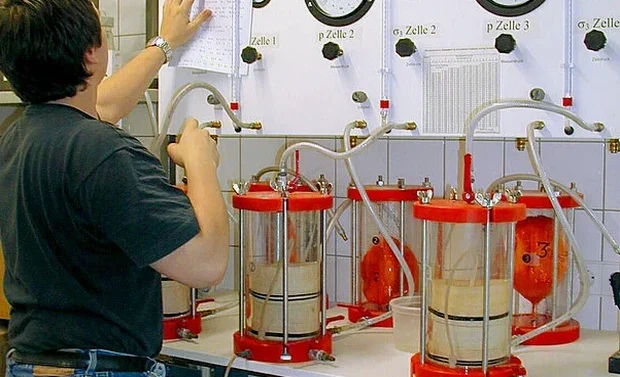
Glendale sits on the edge of the Basin and Range province. The soil deposits are young, geologically speaking. They haven't had millions of years to consolidate. That means variable bearing capacity. We have tested samples from the same lot where one end has a CBR of 3 and the other end has a CBR of 25. That's the alluvial fan effect. You can hit an old channel filled with loose sand right next to a hard caliche bank. If you design the whole pavement for the average, the weak spots fail early. We see this on arterial roads in older Glendale neighborhoods where the original pavement was built before modern CBR testing was standard practice. The swelling potential of the clay fines here is another factor. During the monsoon, these clays expand. The soaked CBR test captures this behavior directly by measuring the swell percentage during the four-day soaking period.
Reference standards
ASTM D1883: Standard Test Method for California Bearing Ratio (CBR) of Laboratory-Compacted Soils, ASTM D698: Standard Test Methods for Laboratory Compaction Characteristics of Soil Using Standard Effort, ASTM D1557: Standard Test Methods for Laboratory Compaction Characteristics of Soil Using Modified Effort, AASHTO T 193: Standard Method of Test for The California Bearing Ratio, IBC Section 1803: Geotechnical Investigations and soil-bearing capacity requirements
Related services
Standard CBR Testing (Soaked and Unsoaked)
Full ASTM D1883 procedure on remolded samples. Includes compaction curve, 96-hour soak, swell measurement, and penetration test. We report CBR values at 0.1 in and 0.2 in penetration, plus the corrected bearing ratio. Typical for street widening, parking lots, and residential subdivisions in Glendale.
CBR Correlation Packages with R-Value
For Arizona DOT and Maricopa County projects that require R-value design inputs, we run the CBR test and offer a correlated R-value based on the Hveem stabilometer correlation. This is common when the project specs call for R-value but the available soil data is CBR-based.
Typical parameters
Common questions
How much does a laboratory CBR test cost in Glendale?
A standard single-point CBR test on a remolded sample typically runs between US$130 and US$220, depending on whether we run the Proctor compaction test alongside it and how many points you need. A three-point CBR curve with Proctor is at the higher end of that range.
How long does the CBR test take from sample drop-off to report?
The soaking period alone is 96 hours. Add compaction, setup, penetration testing, and reporting, and the standard turnaround is 5 business days. We can expedite to 4 days if you drop off the sample early Monday morning.
Do you need a Proctor test before running the CBR?
Yes. The CBR sample must be compacted at a known moisture and density, usually optimum moisture from a Standard or Modified Proctor. If you don't have that data yet, we run the Proctor first on your material, then compact the CBR mold to those targets.
What soil types in Glendale cause the lowest CBR values?
The fat clays we find in some older agricultural areas of Glendale tend to give the lowest soaked CBR values, sometimes as low as 2 or 3. These soils hold water, swell, and lose strength dramatically. The sandy silts near the Agua Fria River can also drop to CBR 5-7 when saturated.
Can you test base course aggregates for CBR?
Yes. We test crushed aggregate base (AB) and recycled concrete aggregate (RCA) per ASTM D1883. For coarse aggregates, we use a scalping procedure to replace oversized particles. Typical soaked CBR values for good ABC in the Glendale market run between 80 and 120.