Glendale sits on the edge of the Sonoran Desert, where caliche layers and dry, overconsolidated clays demand more than a basic bearing capacity check. Summer monsoons can saturate the upper few feet in minutes, triggering strength loss that only a triaxial test can quantify. We run both consolidated-undrained and unconsolidated-undrained stages to capture the soil's true behavior under the rapid moisture swings common here. For deeper strata where gravel lenses appear, the CPT test helps us pick undisturbed sampling depths before the triaxial cell ever gets pressurized. The city's elevation near 353 meters means thermal fluctuation during transport; our sealed sample containers prevent moisture loss on the way to the lab.
Effective friction angles from a drained triaxial test remove the guesswork from retaining wall and slope design in Arizona's cemented soils.
Our approach and scope
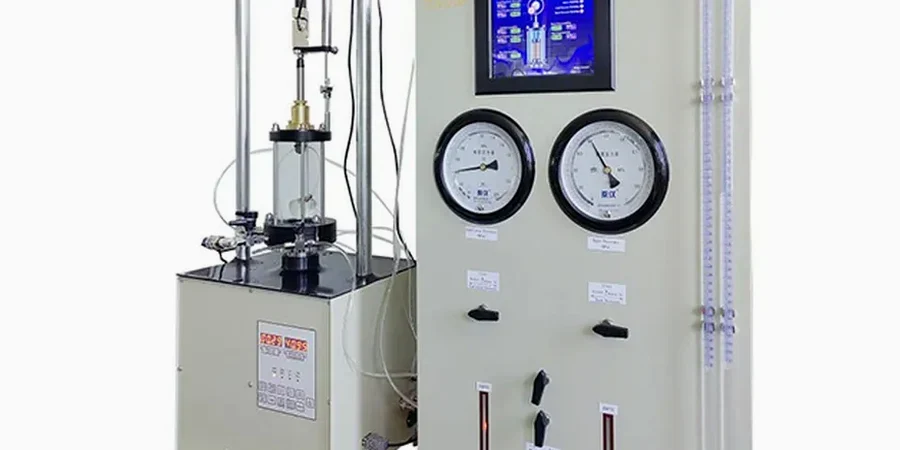
Local context
A common mistake in the Glendale area is running a quick pocket penetrometer on a caliche chunk and assuming that strength governs the entire deposit. Caliche dissolves and softens with irrigation water over time, and the underlying silty clay can lose 40% of its undrained shear strength after just one monsoon cycle. We have seen footings designed with spreadsheets that ignored the true effective cohesion after saturation, leading to differential settlement within the first two years. Running a consolidated-drained triaxial on the weakest layer, not the strongest crust, is what separates a stable foundation from a long-term liability. If you are placing a mat foundation on variable fill, pairing the triaxial with a plate load test adds in-situ stiffness data to back up the lab parameters.
Watch the video
Reference standards
ASTM D4767-11 Standard Test Method for Consolidated Undrained Triaxial Compression Test for Cohesive Soils, ASTM D2850-15 Standard Test Method for Unconsolidated-Undrained Triaxial Compression Test on Cohesive Soils, ASTM D7181-20 Method for Consolidated Drained Triaxial Compression Test for Soils, IBC 2021 Section 1803 Geotechnical Investigations, ASCE 7-22 Minimum Design Loads and Associated Criteria for Buildings and Other Structures
Related services
CU Triaxial (ASTM D4767)
Consolidated-undrained testing with pore pressure measurement. We saturate specimens under back pressure until B≥0.95, then shear at 0.05 %/min. Provides effective stress parameters c' and φ' for slope stability and retaining wall design.
CD Triaxial (ASTM D7181)
Consolidated-drained testing for long-term foundation analysis. Slow strain rates allow full pore pressure dissipation. Ideal for free-draining granular layers found in the Salt River Valley alluvium.
UU Triaxial (ASTM D2850)
Unconsolidated-undrained testing for rapid loading scenarios. We use this for preliminary embankment checks on Glendale clayey sands where construction schedules do not allow for consolidation stages.
Multistage Triaxial
Single-specimen method that applies increasing confining pressure in stages. Useful when sample recovery is limited, such as in highly variable desert soils with interbedded caliche.
Typical parameters
Common questions
What does a triaxial test cost for a Glendale project?
A standard three-specimen triaxial program in Arizona typically runs between US$2,100 and US$3,030, depending on whether you need CU, CD, or UU protocols and how many confining pressures are specified. Multistage tests on a single specimen fall at the lower end of that range.
How long does the lab take to finish a consolidated-drained triaxial?
A CD triaxial is the slowest procedure because we shear at rates of 0.02 to 0.05 percent per minute to keep pore pressures dissipated. Expect seven to fourteen days for a complete three-specimen set after sample trimming starts.
Can you test caliche or cemented gravel in the triaxial cell?
We can test weakly cemented caliche if the specimen is trimmed carefully and the confining pressure is ramped gently. For gravel with particles larger than 1/6 of the specimen diameter, the triaxial is not the right tool. We would recommend an in-situ shear test or a large-scale direct shear box instead.
Which ASTM standard applies to Glendale silty sands?
For silty sands with low plasticity, ASTM D4767 for CU conditions or ASTM D7181 for CD conditions. If the material is truly non-cohesive and free-draining, we follow ASTM D7181 and use dry pluviation to prepare the specimen.
Do I need a triaxial test or is an unconfined compression test enough?
An unconfined test only works for intact rock or heavily cemented soil. Glendale soils are rarely cohesive enough to stand without lateral support. A triaxial test applies realistic confining pressure that mimics the in-situ stress state, and it gives you both strength and stiffness parameters that an unconfined test cannot offer.