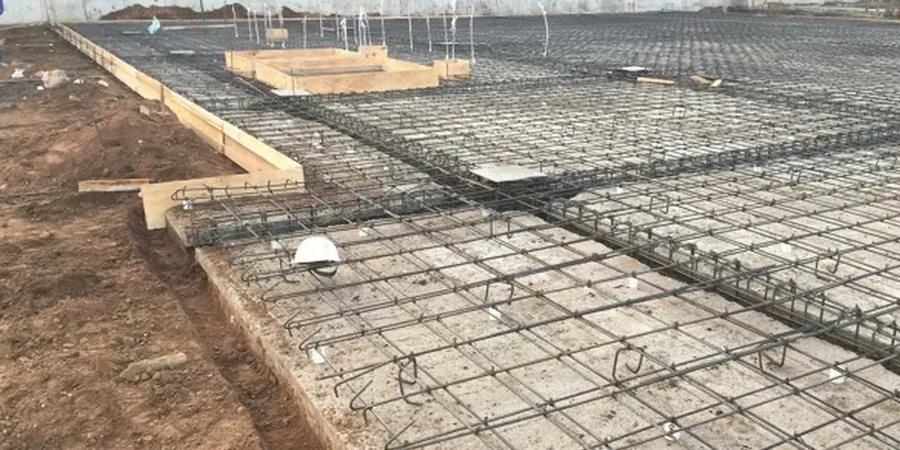
The International Building Code (IBC 2021) and ASCE 7-22 set the baseline for structural loads, but in Glendale, Arizona, the real design driver lies beneath the surface. The city sits at an elevation of roughly 1,150 feet within the Salt River Valley, where Holocene alluvium dominates and clay fractions routinely exceed 30 percent. A raft or mat foundation becomes the logical structural response when bearing pressures are modest but differential movement is the enemy. Our laboratory characterizes the entire soil column before a single reinforcement bar is sized, correlating Atterberg limits with swell-consolidation curves to define the stiffness modulus that the mat must counteract. Because the interaction between slab and soil here depends on moisture flux at just a few feet depth, we integrate CPT testing to map continuous stratigraphy and detect thin silt lenses that can concentrate strain under thermal cycles.
Raft design in Glendale succeeds or fails on the active zone: if you don't nail the depth of seasonal moisture change, the mat becomes a rigid lid over a swelling piston.
Our approach and scope
Local context
Glendale records less than nine inches of annual rainfall, yet the risk to a mat foundation intensifies precisely during the monsoon when flash floods send water racing across the Basin and Range topography. The contrast between bone-dry clay and a suddenly soaked profile can generate heave pressures above 6,000 psf in less than 48 hours. Without a properly parameterized raft design, edge curl and center doming appear within the first two seasonal cycles, cracking floor slabs and racking partition walls. The critical failure mode we see repeatedly is not bearing capacity collapse but serviceability loss: doors that jam, tiles that pop, and plumbing that shears at the wall line. A rigorous investigation that quantifies the active zone depth and the soil water characteristic curve lets the structural engineer size the mat thickness, edge beams, and reinforcement layout to keep angular distortion below 1/500, the threshold where occupants start noticing problems.
Watch the video
Reference standards
IBC 2021 – Chapter 18 Soils and Foundations, ASCE 7-22 – Minimum Design Loads for Buildings, ACI 360R-10 – Guide to Design of Slabs-on-Ground, ASTM D4546 – Standard Test Methods for One-Dimensional Swell or Collapse of Soils, ASTM D2487 – Unified Soil Classification System
Related services
Soil-Structure Interaction Modeling
Finite element analysis of the mat-soil system using moisture-dependent subgrade modulus, calibrated to site-specific swell and consolidation data from the subject lot in Glendale.
Active Zone Profiling
Seasonal moisture monitoring with nuclear density gauges and suction sensors to establish the true depth of moisture fluctuation before mat dimensions are locked.
Post-Tensioned Mat Detailing
Layout and tendon stressing diagrams for ribbed or uniform-thickness mats where active cracking control is required, compliant with PTI DC10.5 guidelines.
Typical parameters
Common questions
What does a raft foundation design cost for a typical single-family home in Glendale?
For a standard residential lot in Glendale, the geotechnical investigation and raft foundation design package typically falls between US$1,020 and US$3,800. The final figure depends on the number of borings required, the depth of the active zone, and whether seasonal moisture monitoring is needed before finalizing the mat parameters.
How does the expansive clay in Glendale specifically affect mat foundation performance?
The clay-rich alluvium of the Salt River Valley can swell vertically by 2 to 4 inches across a 30-foot mat when wetted, but rarely does so uniformly. The perimeter dries faster than the center, creating a bowl-shaped deformation that cracks the slab at the middle third. Our design compensates by deepening the edge beams and specifying reinforcement that bridges the expected tension zone.
Which soil tests are mandatory before designing a raft foundation in the Phoenix metro area?
At a minimum, we require Atterberg limits (ASTM D4318), one-dimensional swell-consolidation (ASTM D4546), and a full particle-size distribution (ASTM D6913/D7928) from each distinct stratum within the active zone. Without the swell pressure curve and the expansion index, the mat thickness and reinforcement cannot be rationally selected.