We were called out to a new industrial park off Loop 303 near Luke Air Force Base a few years back. The contractor had poured a 6-inch unreinforced concrete slab over native soil the previous spring. By July, the center joints had curled and three panels had cracked right through the dowel baskets. Glendale’s summer isn’t just hot — it punishes bad pavement design. With daily highs pushing 110°F for weeks on end, concrete expands and contracts in ways that a generic thickness table simply won’t handle. We redesigned the section using a tied shoulder and a lean concrete subbase over lime-stabilized subgrade. That slab is still in service, no faulting, no blowups. That’s the difference between pouring concrete and engineering a rigid pavement system that accounts for Arizona’s specific thermal gradient, soil chemistry, and drainage patterns.
Glendale’s 300-plus days of sunshine a year are an asset for curing concrete — but only if the mix design and joint spacing account for a 40°F daily temperature swing.
Our approach and scope
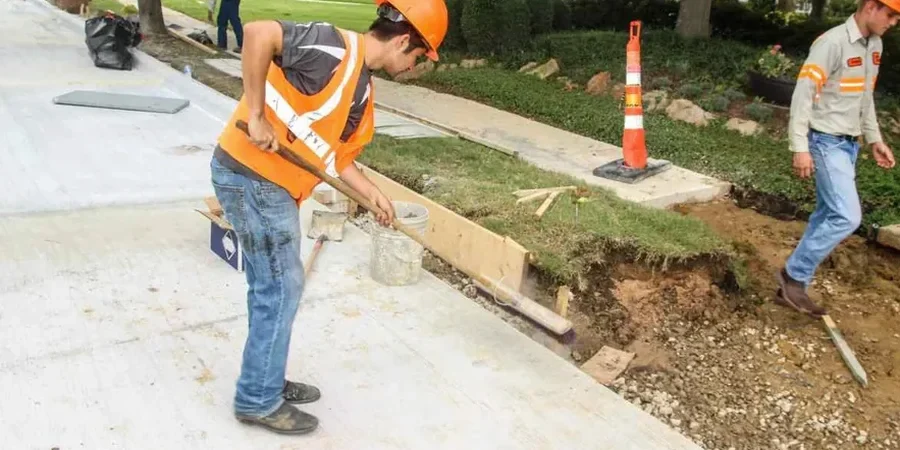
Local context
The most expensive mistake we see in Glendale is skipping the sulfate test. Maricopa County has mapped zones with sulfate concentrations exceeding 0.5% by weight in the top 3 feet of soil — enough to cause severe sulfate attack on conventional Portland cement concrete within 5 to 7 years. The damage starts as map cracking at the slab edges, then progresses to full disintegration of the paste matrix. If you’re building a tilt-up warehouse on the west side near the New River, that’s not a theoretical risk — we’ve cored failed slabs there and the pH at the base was below 10 after just four monsoon seasons. The fix costs 3x the original pour. The alternative is a Type V sulfate-resistant cement or a blended cement with fly ash above 25%, specified upfront. Another common error is tying rigid pavement to existing asphalt without a transition slab — the differential settlement at the interface creates a trip hazard and a maintenance headache that never goes away.
Reference standards
AASHTO Guide for Design of Pavement Structures (1993, with 1998 supplement), ASTM C78 / C78M — Flexural Strength of Concrete (Simple Beam with Third-Point Loading), ASTM D2487 — Unified Soil Classification System (USCS) for subgrade characterization, ASTM C1580 — Water-Soluble Sulfate in Soils (for sulfate attack risk assessment), PCA EB204 — Subgrades and Subbases for Concrete Pavements, IBC Chapter 18 — Soils and Foundations (adopted by City of Glendale)
Related services
Concrete Thickness Design
We use AASHTO 93 and the PCA method to determine slab thickness for your traffic loading, subgrade modulus, and concrete flexural strength. Outputs include joint layout, dowel sizing, and tie bar schedules.
Subgrade Stabilization Specification
Based on plasticity index and sulfate content from our lab, we specify lime, cement, or fly-ash treatment depths and percentages to create a non-expansive, non-reactive platform under the slab.
Jointing Plan & Detailing
We design contraction, construction, and isolation joints for Glendale’s thermal range, including skewed joints at intersections and thickened edge details at loading docks.
Forensic Evaluation & Rehabilitation
For existing rigid pavement with cracking, faulting, or ASR, we core, test, and deliver a rehabilitation plan — from full-depth repair to diamond grinding and dowel bar retrofit.
Typical parameters
Common questions
How much does a rigid pavement design package cost for a commercial project in Glendale?
For a typical commercial lot or warehouse approach in Glendale — say 20,000 to 60,000 square feet — a full design package including subgrade investigation, sulfate testing, thickness design, and jointing plan runs between US$2,120 and US$6,610 depending on geotechnical complexity and plan check requirements.
How does rigid pavement handle Glendale’s monsoon flooding better than asphalt?
Concrete doesn’t soften under standing water the way asphalt binder does. In Glendale, where flash floods can pond on low-lying commercial pads for hours, rigid pavement maintains its structural capacity and doesn’t rut. The key is proper subdrainage — we design edge drains and permeable bases to prevent pumping at joints during rapid moisture changes.
What concrete mix is best for sulfate soils in the West Valley?
Sulfate concentrations above 0.2% by weight require Type II cement; above 0.5%, we specify Type V or a blend with at least 25% Class F fly ash per ASTM C618. We always run a sulfate solubility test on Glendale subgrade samples before writing the mix design, because sulfate pockets in the Agua Fria alluvium are unpredictable and localized.
How long does a rigid pavement design take from field investigation to stamped drawings?
A typical Glendale project takes 3 to 4 weeks: one week for drilling, sampling, and DCP or plate load testing, one week for lab work (grain size, Atterberg, sulfate, and compressive strength cylinders), and one to two weeks for engineering analysis, thickness design, and preparation of stamped construction documents.