When you hit soft alluvium at four feet and the water table shows up right behind it, conventional footings stop making sense fast. That scenario plays out regularly across Glendale, particularly near the Agua Fria River corridor and in older agricultural parcels where silts and clays extend twenty feet or more before reaching competent desert conglomerate. We have designed stone columns for warehouse pads near Loop 101, multi-story buildings in the Westgate area, and industrial tanks where total settlement had to stay under one inch. The method works because it densifies the matrix, provides a vertical drainage path for pore pressure dissipation, and transfers load to a composite mass that behaves predictably. Before committing to the design, we typically run a CPT test to map the soft zones with continuous tip resistance and sleeve friction profiles — CPT data tells us exactly where the columns need to go and how deep to take them before refusal on the caliche layer that underlies much of the Glendale basin.
A well-designed stone column grid cuts primary settlement by 60 to 80 percent and eliminates the post-earthquake reconsolidation settlement that can render a structure unusable.
Our approach and scope
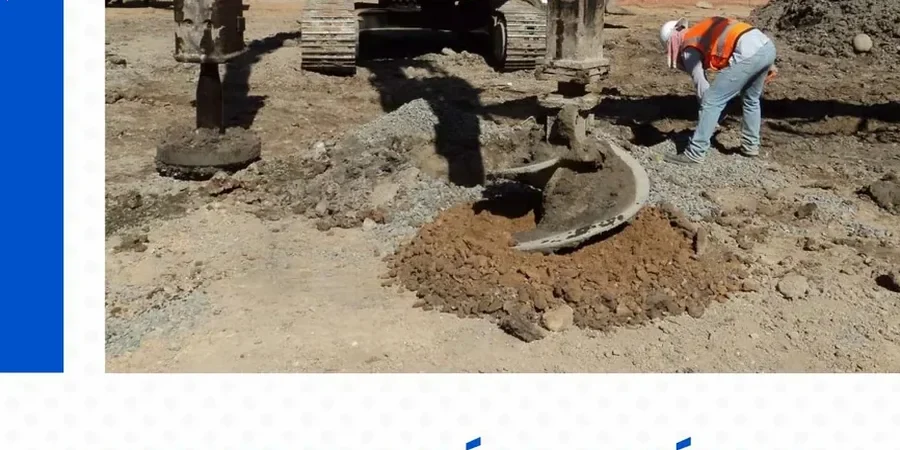
Local context
The mistake we see repeatedly in Glendale is treating stone columns as a generic ground improvement item on a bid form without a site-specific design. A contractor quotes a unit price per linear foot based on assumed depths, then discovers the soft zone extends ten feet deeper than expected — or worse, encounters groundwater artesian conditions in a buried channel that collapses the hole before the stone can be placed. Without a pre-design investigation that includes pore pressure measurement and a grain size analysis to quantify fines content, the column spacing ends up too wide, the settlement exceeds the project tolerance, and the owner faces a costly remediation. Another common error: specifying stone columns under a rigid mat foundation without accounting for the stress concentration that occurs at the column heads, which can punch through the load transfer platform if the geotextile reinforcement is underspecified. We address these issues during design by running sensitivity analyses on column length, diameter, and spacing, then locking the installation parameters into a performance specification with pass/fail criteria verified by post-installation modulus tests.
Reference standards
ASCE 7-22 Chapter 12 (Seismic Design), IBC 2024 Section 1803 (Geotechnical Investigations), ASTM D1586 (Standard Penetration Test), ASTM D2487 (Soil Classification), FHWA NHI-16-072 Ground Improvement Manual
Related services
Feasibility and settlement analysis
We run Priebe method calculations and 2D finite element models to predict total and differential settlement under your foundation loads, comparing stone columns against alternatives like over-excavation or rigid inclusions.
Full design package with construction specs
Stamped drawings showing column layout, depth table, stone gradation, installation sequence, and QA/QC testing requirements — ready for permit submittal to the City of Glendale.
Construction-phase testing and verification
We perform modulus tests, zone load tests, and post-installation CPT soundings to confirm the improved ground meets the design parameters before structural concrete is placed.
Typical parameters
Common questions
How much does a stone column design cost for a project in Glendale?
For a typical Glendale commercial or industrial site, the design package runs between US$1,440 and US$4,910 depending on the building footprint, number of column locations, and whether we need to perform supplemental field testing beyond the geotechnical investigation already in hand. Projects with complex loading — like heavily-loaded rack systems or crane foundations — fall toward the upper end because of the additional analysis required.
How do stone columns compare to over-excavation in Glendale soils?
Over-excavation can work when the soft zone is shallow — under about 8 feet — and groundwater is manageable. In Glendale, however, the basin-fill clays and silts often extend 15 to 30 feet deep with a water table at 5 to 10 feet, making dewatering and haul-off prohibitively expensive. Stone columns let you improve the in-situ material without removing it, which cuts earthwork cost and schedule significantly on deeper soft zones.
What QA/QC testing do you require during stone column installation?
We specify a testing program that includes amperage and penetration rate monitoring on every column during installation, a modulus load test on at least one column per 5,000 square feet of treated area, and post-improvement CPT soundings at locations we select to verify that tip resistance meets the design target throughout the full column depth.