Glendale sits at the northwestern edge of the Salt River Valley, where basin-edge effects amplify ground motion in ways that standard fixed-base structures handle poorly. The transition from deep alluvium near the Agua Fria River to the harder Tertiary sediments along the northern foothills creates sharp impedance contrasts—exactly the conditions where seismic microzonation studies flag higher spectral accelerations at mid-range periods. For critical facilities and essential buildings, our team uses nonlinear time-history analysis with site-specific ground motions to design base isolation systems that decouple the superstructure from those amplified motions. We work within the City of Glendale’s amended IBC provisions and ASCE 7-22 Chapter 17, delivering peer-reviewed isolation designs that target immediate occupancy performance after a design-level earthquake.
A properly tuned base isolation system can cut spectral acceleration demands by 60 to 80 percent, but only if the site-specific basin effects are captured in the ground motion selection.
Our approach and scope
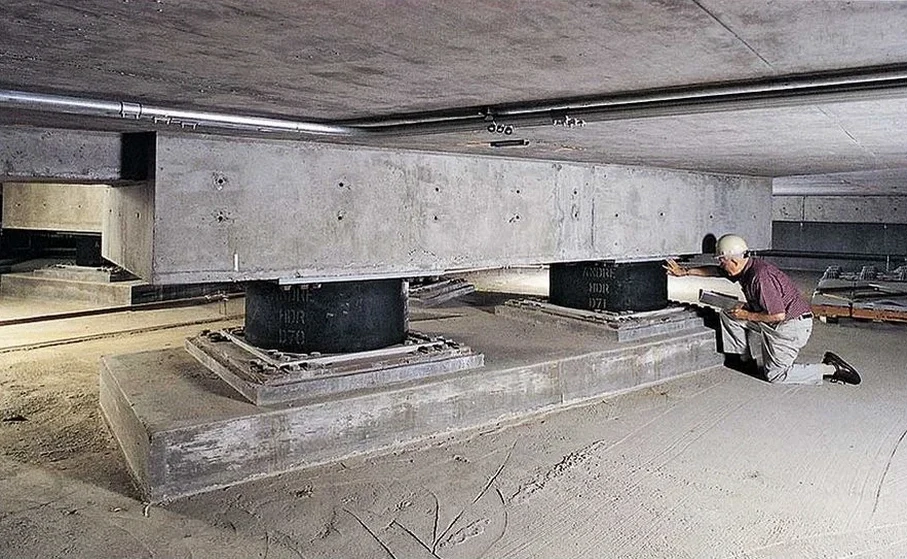
Local context
ASCE 7-22 Section 17.3.2 requires that base-isolated structures be designed for the MCER ground motion, not a reduced design spectrum—this is non-negotiable and carries significant weight in Glendale because the basin-edge geometry can produce spectral ordinates 20 to 40 percent higher than the USGS simplified hazard tool predicts. Skipping site-specific ground motion analysis or defaulting to code-minimum damping values introduces two failure modes: the isolators bottom out under displacement demands larger than the moat clearance, or the superstructure sees acceleration spikes that defeat the isolation intent. We see this risk concentrated in older tilt-up concrete buildings being retrofitted with isolation planes, where the existing foundation stiffness interacts unpredictably with the new isolation layer. A peer-reviewed design package that includes prototype isolator testing per ASTM D4015 or ASCE 7 §17.8 closes that gap before construction begins.
Reference standards
ASCE 7-22 Chapter 17 (Seismic Isolation), IBC 2021 §1705.13.4 (Peer Review), ASTM D4015-21 (Dynamic Testing of Elastomeric Isolators), ASCE 41-23 (Seismic Rehabilitation), AASHTO Guide Specifications for Seismic Isolation Design (for bridge structures)
Related services
Site-Specific Ground Motion Development
We run probabilistic and deterministic seismic hazard analyses (PSHA/DSHA) calibrated to the Glendale basin model, generating spectrum-compatible time histories for nonlinear isolation analysis.
Isolation System Design and Modeling
Complete 3D nonlinear models with isolator hysteretic behavior, moat wall detailing, and utility crossing flexibility checks for ASCE 7 Chapter 17 compliance.
Peer Review Coordination
We prepare design documentation for independent third-party review per IBC §17.13.4 and manage the review comment resolution process with the City of Glendale Building Safety division.
Construction Phase Testing and Inspection
Prototype and production isolator testing oversight, installation tolerance verification, and long-term monitoring system design for post-earthquake rapid assessment.
Typical parameters
Common questions
What does a base isolation design package cost for a Glendale project?
For a typical mid-rise building in Glendale, the full isolation design package—including site-specific ground motion development, nonlinear analysis, and peer review coordination—ranges from US$4,610 to US$7,670 depending on structural complexity and the number of ground motion pairs required.
Does Glendale have specific seismic isolation requirements beyond IBC?
The City of Glendale adopts IBC with local amendments, and the Building Safety division enforces the peer review mandate in IBC §17.13.4 for all isolated structures. Additionally, proximity to the basin edge means reviewers often request basin-effect justification beyond the USGS hazard tool output.
How long does the base isolation design process take?
From feasibility assessment through peer-reviewed final design, a base isolation package typically requires 10 to 16 weeks. The most time-intensive step is the ground motion selection and spectral matching, which involves multiple iterations with the geotechnical team to capture basin amplification accurately.
What type of structures benefit most from base isolation in the Glendale area?
Essential facilities—hospitals, emergency operations centers, data centers—and older concrete shear wall buildings where fixed-base retrofit would be more invasive. The basin-edge amplification in Glendale makes isolation particularly cost-effective for structures with fundamental periods between 1.0 and 2.0 seconds when fixed-base.