Driving a backhoe into the desert floor of Glendale often reveals surprises that no desktop study can predict. The city sits at roughly 1,150 feet elevation in the Salt River Valley, where geology shifts from windblown silt to cemented caliche and pockets of river cobble. Before committing to a foundation design, an exploratory test pit provides direct visual access to those layers. We open trenches typically 8 to 14 feet deep, letting the project geologist log soil stratigraphy, photograph cobble lenses, and measure moisture at depth. For commercial pads near Loop 101 or infill lots around downtown Glendale, this step catches old irrigation berms or buried debris that standard borings miss. In our knowledge, combining a test pit campaign with targeted SPT drilling gives you the most complete picture, especially when the upper 10 feet control your footing bearing capacity.
In Glendale's caliche‑riddled soil, a single exploratory test pit can prevent a multi‑day delay by confirming rippability before the excavation contractor mobilizes.
Our approach and scope
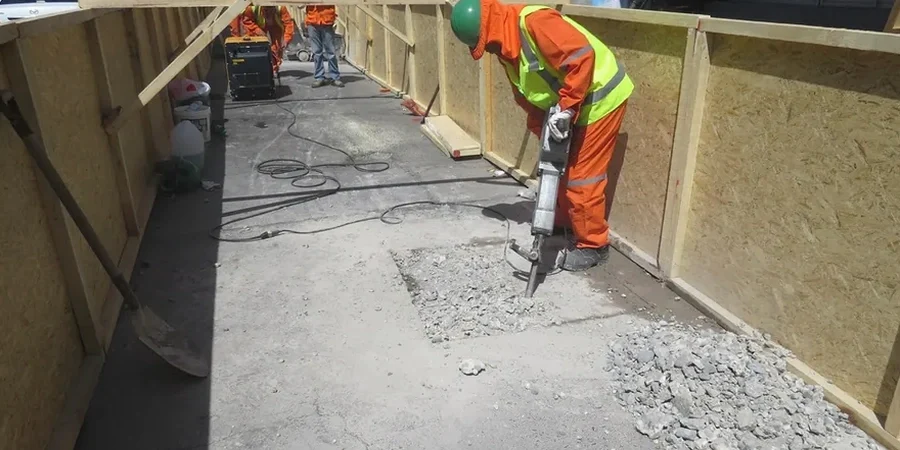
Local context
The most common mistake we see on West Valley jobs is assuming that native desert ground is uniform and undisturbed. Glendale has a patchwork of old agricultural tracts, buried arroyos, and utility trenches that can be invisible from the surface. Skipping an exploratory test pit and relying solely on a few SPT borings can lead to a nasty surprise when the excavator hits a lens of unrecorded fill—old concrete washout, stucco debris, or even asphalt grindings—right under the footing line. That discovery mid‑excavation triggers a stop‑work order, a re‑design scramble, and sometimes a costly over‑excavation. A single test pit, placed where the grading plan shows the deepest cut, lets the structural engineer verify bearing stratum continuity and adjust the foundation depth before the reinforcement cage is tied. It is a low‑tech tool that delivers high‑stakes risk reduction.
Watch the video
Reference standards
ASTM D2487 – Standard Practice for Classification of Soils for Engineering Purposes (Unified Soil Classification System), ASTM D698 – Standard Test Methods for Laboratory Compaction Characteristics of Soil Using Standard Effort, OSHA 29 CFR 1926 Subpart P – Excavations (competent person evaluation for trench safety)
Related services
Test pit logging & stratigraphy
Wall‑by‑wall description of soil texture, plasticity, moisture condition, and caliche hardness using USCS nomenclature. Includes hand‑drawn field sketches refined into CAD‑ready logs.
Infiltration & percolation screening
On‑site double‑ring infiltrometer or open‑pit falling‑head tests performed inside the test pit to support stormwater management design per local ADEQ guidance.
Utility potholing & clearance
Pre‑drilling vacuum potholes or hydro‑excavation window to confirm buried line depths before the backhoe opens the full trench, protecting existing activities.
Combined SPT & pit program
Pairing a shallow test pit with deeper SPT borings to tie surface observations to deeper blow count data, reducing uncertainty across the entire soil column.
Typical parameters
Common questions
What does an exploratory test pit cost on a typical Glendale residential lot?
For a standard single‑family lot in Glendale, the cost generally falls between US$530 and US$950. The final figure depends on pit depth, access for the backhoe, and whether you need a same‑day infiltration test. That price covers the complete field log, digital photographs, and a signed PDF report.
How deep can you go with a test pit in Glendale's soil?
We routinely excavate to 12 or 14 feet with a standard backhoe. Depth is limited by the reach of the arm and by OSHA trench safety rules. If the pit needs to go deeper, we bench the sides or step the excavation, but anything beyond 15 feet usually pushes the project toward a drill rig rather than an open excavation.
Do I still need a test pit if I already have SPT borings on my Glendale site?
SPT borings give you a vertical profile at discrete points, but they do not show lateral continuity the way an open trench does. A test pit is especially helpful where borings hint at variable fill or where you suspect boulders and caliche lenses. Many Glendale projects use one or two pits to ground‑truth the boring log and confirm the top of the bearing stratum across the building footprint.
What happens to the test pit after you finish logging?
The excavation is backfilled the same day using the material we removed, placed in lifts and compacted with a jumping jack or plate compactor. We match the compaction spec required for the future use of the area—typically 95% of standard Proctor. The surface is graded to drain, and we leave the site in a safe, tidy condition.